Contact Center
+84 903419479
Contact Center
+84 903419479
Enterprise 18/08/2026
Vietnam remains a practical destination for foreign investors looking to expand manufacturing, trading, services, technology, or regional business operations. However, the legal position of a foreign investor should be reviewed before capital is transferred, documents are signed, or a local partner is appointed. A sound FDI investment in Vietnam requires more than enthusiasm about the market. It requires a careful check of market access, investment structure, licensing requirements, capital contribution, contracts, and operational compliance.
This article is a pre-investment legal checklist for foreign investors who want to understand what should be reviewed before making FDI in Vietnam.
FDI, in practical terms, means a foreign investor directly participates in a Vietnamese business, project, or company. This may involve establishing a new foreign-invested company in Vietnam, contributing capital to an existing company, purchasing shares, entering a joint venture, or implementing an investment project.
The legal consequences will differ depending on the route chosen. Establishing a new company gives the investor a new legal entity but may require investment registration and enterprise registration. Acquiring shares in an existing company may look faster but requires due diligence on debts, taxes, licenses, labor matters, and ownership history. A joint venture may help with market access or local operations but can create management and control issues if the agreement is not clear.
Foreign investors who are still comparing entry routes may review broader materials on foreign investment in Vietnam, but the key point before committing capital is to identify the exact legal structure that matches the intended business model.

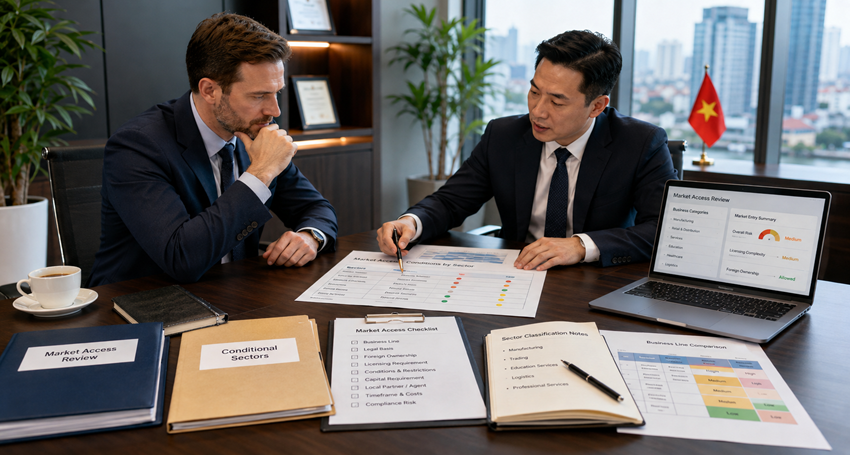
Market access conditions in Vietnam should be checked before an investor chooses the business line, signs a lease, transfers funds, or agrees with a local partner. Some business sectors are generally open to foreign investment, while others may be conditional or require additional licensing review.
A business line that appears simple commercially may still require legal analysis. For example, trading, distribution, education, logistics, e-commerce, advertising, travel, real estate-related activities, or regulated services may involve specific conditions depending on how the business is operated. The issue is not only whether foreign investors may enter the sector, but also what ownership limits, licensing requirements, approvals, or operating conditions may apply.
Foreign investors should not rely only on informal statements that an activity is “allowed.” The proposed activity should be matched against the actual business model, revenue flow, customers, contracts, and location. If the company registers the wrong business line or omits a required activity, later licensing, tax, invoicing, banking, and contract performance may become more difficult. Investors entering sensitive or regulated activities should review foreign investment in conditional sectors in Vietnam before moving ahead.
The investment structure should be chosen before documents are drafted. Common options include a wholly foreign-owned company, a joint venture, capital contribution or share acquisition, business cooperation arrangements, and, in limited cases, a representative office for non-revenue-generating activities.
A wholly foreign-owned company may suit investors who want direct control over management, staffing, contracts, and business strategy. A joint venture may be useful when a Vietnamese partner contributes market knowledge, licenses, land access, relationships, or operating capacity. A capital contribution or share purchase may be suitable when the investor wants to join an existing business, but this route requires careful due diligence.
The structure affects more than incorporation. It can affect tax planning, profit remittance, decision-making authority, exit rights, licensing conditions, and dispute exposure. For example, a joint venture without clear reserved matters may lead to deadlock. A share acquisition without due diligence may transfer hidden risk. A representative office may support market research but is not a substitute for a company that conducts commercial operations.
Before selecting a structure, investors should compare the legal and commercial consequences of different foreign investment options in Vietnam.

Foreign investors should understand whether their proposed investment requires an Investment Registration Certificate, an Enterprise Registration Certificate, or other approvals. These requirements depend on the investment form, business sector, ownership ratio, project location, and intended activities.
For a new foreign-invested company in Vietnam, investment registration may be required before enterprise registration. The Investment Registration Certificate records core project information, while the Enterprise Registration Certificate establishes the company as a legal entity. In other cases, such as capital contribution or share acquisition, a different approval route may apply.
Investors should not treat these steps as a simple administrative formality. Application documents should be consistent with the business model, investment capital, office location, investor identity documents, and intended business lines. Documents issued overseas may require proper preparation before they can be used in Vietnam.
A practical legal review should confirm what approvals are required, which documents must be prepared, and whether the proposed activity can be implemented after registration. Investors planning a new project should consider the investment registration process in Vietnam for foreign investors before making commitments to landlords, partners, or suppliers.

Capital contribution should be planned before money is transferred. Foreign investors should distinguish between charter capital, total investment capital, and the actual operating funds needed for rent, staff, equipment, suppliers, and tax obligations.
In many cases, foreign capital should be transferred through the proper investment capital account or other legally appropriate banking channel. Informal transfers to individuals, local partners, or unrelated accounts may create problems later when the company needs to prove lawful capital inflow, update corporate records, remit profits, or restructure ownership.
The amount of capital should also be realistic. Too little capital may make the project difficult to operate and may raise questions about financial capacity. Too much capital may create unnecessary pressure if the investor has not planned contribution obligations, cash flow, and future funding needs.
Investors should also check whether capital contribution timing, currency, bank documentation, and accounting records are aligned with the approved investment structure. Poor capital documentation can become a serious issue during tax review, shareholder disputes, or capital transfer or exit.

Foreign investors often sign documents before they fully understand the Vietnamese legal consequences. This may include term sheets, memoranda of understanding, nominee arrangements, shareholder agreements, office leases, distribution contracts, supplier agreements, and management authorization documents.
Local partner arrangements require particular care. A partner may be commercially useful, but the investor should verify corporate status, ownership, authority, debt exposure, tax compliance, and litigation history where relevant. If the partner will hold shares, manage licenses, or control operations, the legal documents must clearly regulate voting rights, reserved matters, capital contribution, profit distribution, non-compete obligations where appropriate, confidentiality, dispute resolution, and exit rights.
Nominee arrangements can be risky. If a foreign investor relies on a local person or company to hold assets, sign documents, or control a business without enforceable protections, the investor may lose practical control. Such structures should be reviewed carefully before use.
Lease contracts should also be checked. The premises should be suitable for the registered business activities, licensing requirements, and operational plan. A lease that cannot support registration or sub-licensing may delay the entire project.

Before starting operations, foreign investors should identify the main legal risks that may affect the investment. Common issues include:
These risks are easier to manage before the investment is made. Once capital has been transferred, staff hired, premises leased, or contracts signed, correcting the structure may become more expensive and more difficult.

Foreign investors should consult a Vietnam investment lawyer before signing term sheets, transferring capital, incorporating a company, buying shares, or appointing a local partner. Legal advice is also important before expanding business lines, changing ownership, increasing capital, relocating premises, or applying for additional licenses.
A lawyer can help the investor test whether the proposed structure is legally workable, identify market access conditions, review documents, assess local partner risks, and reduce avoidable compliance issues. This does not mean every legal risk can be eliminated. It means the investor can make decisions with a clearer understanding of the requirements and consequences.
Investors should also seek advice when a licensing issue, shareholder disagreement, contract breach, tax concern, labor issue, or regulatory question arises. Early advice may help prevent a manageable issue from becoming a larger dispute.
.jpg.png)
APOLO LAWYERS—Solicitors & Litigators assists foreign investors with practical legal support before and during investment implementation in Vietnam. Our support may include investment structuring, market access review, licensing advice, company formation in Vietnam, contract review, shareholder arrangements, compliance guidance, and dispute prevention.
For investors establishing a new company, legal support may include reviewing the proposed business model, preparing required documents, and advising on the process of establishing a foreign invested enterprise in Vietnam. For investors entering an existing company, support may include due diligence, transaction document review, and post-completion compliance planning.
Foreign investors should obtain legal advice before transferring capital, signing local partner agreements, or applying for investment approvals in Vietnam. APOLO LAWYERS—Solicitors & Litigators can assist with investment structuring, licensing, company setup, contract review, and ongoing compliance support.

Address: 108 Tran Dinh Xu Street, Cau Ong Lanh Ward, Ho Chi Minh City, Vietnam
Tel: (+8428) 66.701.709 | (+84) 908.043.086
Email: contact@apolo.com.vn
Hotline: (+84) 903.600.347
Address: 9th/F, Tower K&M Building, 33 Ung Van Khiem St., Thanh My Tay Ward, HCM City, Vietnam
Tel: (+8428) 35.059.349 | (+84) 908.097.068
Email: contact@apolo.com.vn
Hotline: (+84) 979.48.98.79