Contact Center
+84 903419479
Contact Center
+84 903419479
Dispute 22/08/2023
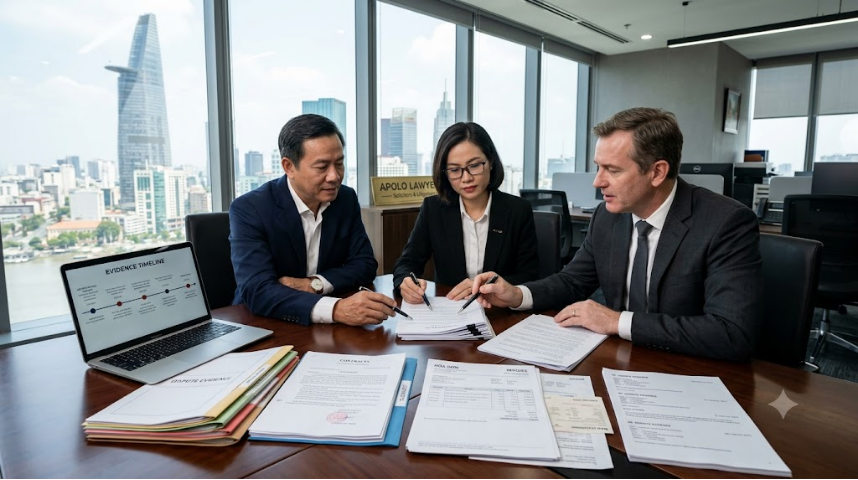
In the realm of commerce, purchase and sale contracts serve as the cornerstones of transactions, creating a legally binding agreement between parties involved in buying and selling goods or services. These contracts provide a structured framework for the exchange of value, detailing the terms, conditions, and obligations of both parties. However, despite the meticulous drafting and intention to create a harmonious transaction, disputes can still arise, posing challenges that need to be resolved. Please contact immediately Apolo Lawyers Law Firm via email contact@apolo.com.vn or hotline - 0903.419.479 for legal advice and support.
The concept of a property sale and purchase contract is defined by the law in Clause 1, Article 430 of the Civil Code 2015: “A property sale and purchase contract is an agreement between the parties whereby the seller transfers the ownership of the property to the buyer. the buyer and the buyer pay the seller”.
 Procedures For Settling Property Purchase And Sale Contract Disputes
According to the provisions of Point a, Clause 1, Article 35 of the 2015 Civil Procedure Code, the district-level People Courts have jurisdiction to settle civil disputes specified in Article 26 of the 2015 Civil Procedure Code (including: disputes over civil transactions and civil contracts), so the district-level People Courts have jurisdiction to settle property purchase and sale contract disputes.
However, for property purchase and sale contract disputes in which the involved parties or assets are located abroad or the judicial entrustment is required to the overseas representative agency of the Socialist Republic of Vietnam, for Foreign competent courts and agencies are not under the jurisdiction of the district-level People Courts but under the jurisdiction of the provincial-level People Courts (based on Point c, Clause 1, Article 37 of the Code of Criminal Procedure). Civil Litigation 2015).
The jurisdiction of territorial courts to settle contractual disputes is determined as follows:
To initiate a lawsuit against a property purchase and sale contract, the petitioner needs to prepare a dossier including the following documents:
Preparing full documents helps the dispute resolution process to be faster.
Thus, the petition must be accompanied by documents and evidences proving that the lawful rights and interests of the petitioner have been infringed. If, for objective reasons, the plaintiff cannot submit all documents and evidences attached to the lawsuit petition, he/she must submit existing documents and evidences to prove the lawful rights and interests of the petitioner. violated. The plaintiff shall supplement or hand over other documents and evidences at the request of the court during the settlement of the case.
The procedure for resolving property sales contract disputes is relatively simple. The petitioner only needs to follow the following 4-step procedure:
According to Article 190 of the 2015 Civil Procedure Code, the plaintiff sends a lawsuit petition, enclosed with documents and evidences that he currently has, to a court competent to handle the case by the following methods:
After receiving the lawsuit petition, the Court must consider necessary documents and evidences. If it is deemed within its competence, the Court will notify the involved parties so that the involved parties can pay the court fee advance.
Within 07 days from the date of receiving the notice, the involved parties must pay the court fee advance. After paying the court cost advance, the involved parties shall return the receipt of the court fee advance to the Court. The court accepts the civil matter or civil case from the date of receipt of this receipt. (Based on Article 195 of the Civil Procedure Code 2015).
Article 203 of the 2015 Civil Procedure Code stipulates the time limit for trial preparation of cases as follows:
During the trial preparation stage, the judge assigned to handle the case must take testimonies of the involved parties, conduct meetings to check the handover, access and publicize evidences and conciliate, conduct conducting on-site review, appraisal or valuation, entrusting evidence collection (if any).
Pursuant to the provisions of Chapter XX, XXI of the Civil Procedure Code 2015, then:
Within 01 month from the date of issuance of the decision to bring the case to trial, the court must open a court session; in case there is a plausible reason, the time limit for opening a court hearing may be extended but must not exceed 30 days.
If the judgment of the first-instance court is appealed or protested against, the immediate superior court shall consider and settle it according to appellate procedures. Accordingly, the appellate court shall re-trial the case in which the judgment or decision of the first-instance court which has not yet taken legal effect is appealed or protested against. The involved parties or their lawful representatives have the right to appeal against the first-instance court judgment or decision to suspend or terminate the settlement of the case to request the appellate court to re-settle it according to the procedures. appellate procedure.
In addition, the case may also be reviewed according to cassation or reopening procedures:
 Procedures For Settling Property Purchase And Sale Contract Disputes
Purchase and sale contract disputes can disrupt the flow of commerce and strain relationships between parties. While disagreements are almost inevitable, approaching them with clear communication, a commitment to finding common ground, and an understanding of legal options can lead to effective resolution. By adhering to well-drafted contracts and preventive measures, parties can mitigate the risk of disputes and ensure smoother transactions in the complex world of commerce. Please feel free to contact Apolo Lawyers Law Firm via email contact@apolo.com.vn or hotline - 0903.419.479 for legal advice and support.
View more: Civil Disputes In Vietnam
View more: Dispute Settlement In Business Investment Activities
APOLO LAWYERS
Address: 108 Tran Dinh Xu Street, Cau Ong Lanh Ward, Ho Chi Minh City, Vietnam
Tel: (+8428) 66.701.709 | (+84) 908.043.086
Email: contact@apolo.com.vn
Hotline: (+84) 903.600.347
Address: 9th/F, Tower K&M Building, 33 Ung Van Khiem St., Thanh My Tay Ward, HCM City, Vietnam
Tel: (+8428) 35.059.349 | (+84) 908.097.068
Email: contact@apolo.com.vn
Hotline: (+84) 979.48.98.79