 Divorce consultation in Vietnam is an important first step for foreigners who are considering ending their marriage under Vietnamese law. Whether the marriage involves a Vietnamese spouse, two foreign nationals living in Vietnam, or a spouse residing overseas, divorce may raise legal questions that require careful consideration before formal proceedings begin.
Foreigners often encounter difficulties involving court jurisdiction, marriage certificates issued abroad, child custody, property ownership, and communication with Vietnamese authorities. These matters may become particularly complicated when spouses disagree about the divorce or when relevant documents and assets are located in different countries.
Seeking advice from an experienced divorce lawyer can help foreign individuals understand their legal position, identify potential risks, and prepare the necessary documents. A properly structured consultation also helps determine whether divorce proceedings can be initiated in Vietnam and what practical steps should follow.
When Should Foreigners Seek Divorce Consultation in Vietnam
Foreign nationals may need divorce legal advice in Vietnam under different circumstances. The appropriate legal approach depends on the nationality and residence of the spouses, where the marriage was registered, and the issues requiring resolution.
When One Spouse Is Vietnamese and the Other Is a Foreign National
International marriages between Vietnamese citizens and foreign nationals are increasingly common. However, when a marriage breaks down, the spouses may face questions about which country's courts have jurisdiction and how their respective rights should be protected.
A foreign spouse considering divorce in Vietnam should obtain legal advice regarding:
-
Whether Vietnamese courts have jurisdiction over the divorce.
-
The legal validity and documentation of the marriage.
-
The availability of mutual consent or unilateral divorce procedures.
-
Child custody and parental responsibilities.
-
Property ownership and financial obligations.
-
The legal implications of one spouse living outside Vietnam.
For example, a foreign husband married to a Vietnamese citizen may wish to divorce while continuing to reside overseas. Before filing a petition, he should determine whether the case can be handled by a Vietnamese court and what documents or procedural arrangements may be required.
Early consultation can help clarify these issues and reduce the risk of unnecessary procedural difficulties.
When Both Spouses Are Foreigners Living in Vietnam
Divorce involving two foreign nationals residing in Vietnam may present additional questions about jurisdiction and applicable law.
Living in Vietnam does not automatically mean that every divorce between foreign spouses can be resolved by a Vietnamese court. The circumstances of the marriage, residence status, relevant international agreements, and applicable legal provisions must be examined.
During a divorce consultation, a lawyer may review the spouses' residence arrangements, marriage documentation, nationality, and connections to Vietnam.
This assessment helps determine whether proceedings in Vietnam are legally available and whether another jurisdiction may be more appropriate.
When a Spouse Lives Outside Vietnam
Divorce becomes more procedurally complex when one spouse resides overseas.
Challenges may arise concerning the service of court documents, obtaining evidence from another country, arranging participation in proceedings, and complying with procedural requirements.
A foreign spouse living abroad should discuss whether Vietnamese courts have jurisdiction, how overseas documents should be prepared, and whether personal attendance may be required.
These questions are particularly important when the parties disagree about the divorce or when disputes involve children and property located in Vietnam.
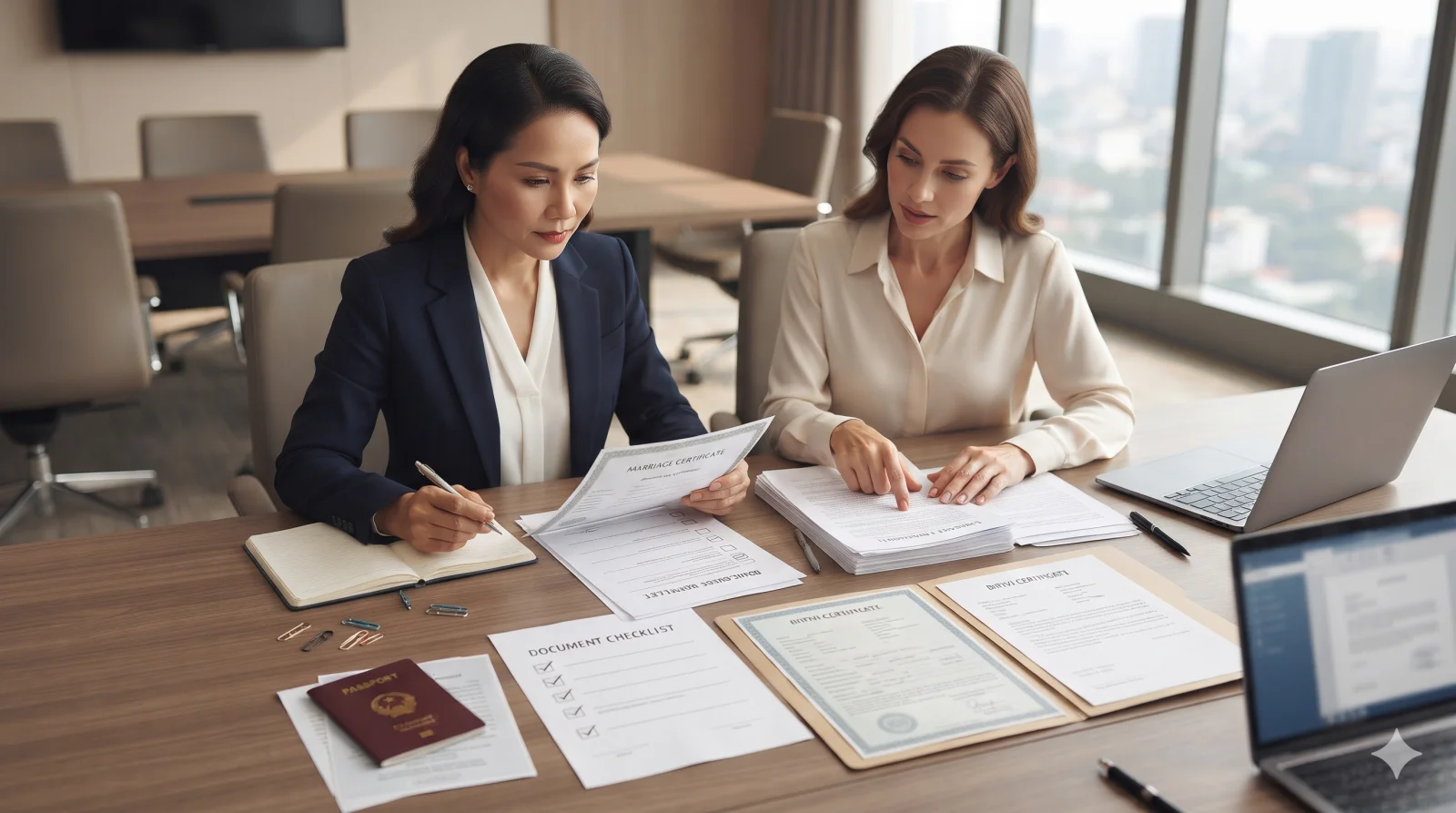
What Documents Should You Prepare Before Meeting a Divorce Lawyer

Preparing relevant documents before a divorce consultation allows the lawyer to understand the circumstances more accurately and provide advice based on available evidence.
Not every document is required for an initial consultation. However, providing essential information at an early stage may help identify missing evidence and potential procedural obstacles.
Marriage Certificate and Identification Documents
The marriage certificate is one of the most important documents in a divorce matter because it helps establish the existence and legal status of the marriage.
Foreign clients should prepare, where available:
-
A marriage certificate issued in Vietnam or overseas.
-
Passport copies and other identification documents.
-
Relevant residence or immigration documentation.
-
Information concerning the date and place of marriage.
-
Previous divorce judgments or marital status documents, where relevant.
If the marriage certificate was issued outside Vietnam, additional requirements concerning translation, certification, or consular legalization may apply, subject to the applicable rules and exemptions.
A lawyer can review the available documentation and explain what may be necessary before formal proceedings begin.
Residence Information and Documents Issued Overseas
Court jurisdiction may depend partly on the residence or location of the parties and other legally relevant circumstances.
Foreign clients should therefore provide accurate information about their current residence, their spouse's residence, and any previous addresses relevant to the case.
Documents issued overseas may also require additional preparation before being submitted to a Vietnamese court.
The requirements depend on the type of document, the issuing country, applicable treaties, and the intended use of the document in Vietnam.
Identifying these requirements early can help avoid delays caused by incomplete or improperly prepared documentation.
Evidence Relating to Children, Property and Marital Disputes
When divorce involves disputed issues, clients should also prepare supporting documents.
These may include:
-
Birth certificates of children.
-
Evidence concerning children's living arrangements and education.
-
Financial and employment information relevant to child support.
-
Property ownership records.
-
Bank statements and relevant financial documents.
-
Loan agreements and evidence of financial obligations.
-
Communications or other lawfully obtained evidence relevant to marital disputes.
The purpose of collecting these documents is not simply to build a larger file. Each document should be evaluated for its legal relevance, reliability, and usefulness in addressing a specific issue.
Clients should avoid altering documents or obtaining private information through unlawful methods.
Key Legal Issues to Discuss During a Divorce Consultation

An effective divorce consultation should go beyond explaining basic filing procedures. It should identify the legal questions that could significantly affect the outcome and practical consequences of the divorce.
Court Jurisdiction and Applicable Legal Procedures
One of the first questions is whether a Vietnamese court has authority to hear the case.
Jurisdiction may depend on factors such as the parties' nationality, residence, the nature of the dispute, and the presence of foreign elements.
Clients should also understand the difference between mutual consent divorce and unilateral divorce.
A mutual consent divorce generally involves both spouses agreeing to end the marriage and reaching arrangements that satisfy the applicable legal requirements. A unilateral divorce involves one spouse seeking a court decision without the other spouse's agreement.
The existence of an international element may affect the competent court and the procedures required.
For a broader explanation of these matters, foreign clients can refer to divorce proceedings involving foreign elements in Vietnam.
Child Custody and Financial Support
When the spouses have children, custody and financial support are often among the most sensitive issues.
Vietnamese law places significant importance on the rights and interests of children when determining post-divorce parental arrangements.
Relevant circumstances may include the child's age, living environment, caregiving history, and each parent's ability to provide suitable care and support.
In international divorce cases, additional questions may arise about the child's nationality, residence, schooling, and potential relocation overseas.
Foreign parents should not assume that nationality alone determines custody.
Instead, they should obtain legal advice about the applicable criteria, available evidence, and the practical consequences of proposed arrangements.
More information is available in the guide to child custody for foreigners in Vietnam.
Property Division and Financial Obligations
Property disputes can become particularly complex when the spouses own assets in different countries or have made significant financial contributions during the marriage.
During a divorce consultation, clients should discuss:
-
Property acquired before and during the marriage.
-
Real estate and other assets located in Vietnam.
-
Ownership and financial contributions.
-
Business interests and investment holdings.
-
Bank accounts and other financial assets.
-
Joint debts and outstanding financial obligations.
-
Any applicable marital property agreements.
Vietnamese law distinguishes between separate property and common marital property, subject to the applicable rules and evidence.
However, the classification and division of property depend on the facts and legal circumstances of each case.
Foreign ownership restrictions, especially those concerning land and certain property interests, may also require separate legal analysis.
Clients should avoid transferring or disposing of disputed assets without first understanding the potential legal consequences.
Recognition of Foreign Marriages and Divorce Decisions
Some foreign clients were married outside Vietnam or have already obtained a divorce judgment from a foreign court.
These situations require careful consideration because recognition of marriage documentation and recognition of foreign divorce judgments are distinct legal matters.
A marriage registered overseas may require appropriate documentation before Vietnamese authorities can rely on it for a particular legal procedure.
Similarly, a foreign divorce judgment does not necessarily have the same legal effect in Vietnam in every circumstance.
The applicable recognition or registration requirements depend on the nature of the decision, relevant Vietnamese law, and any applicable international agreements.
A lawyer should assess these matters before recommending additional proceedings or administrative steps.
How an English Speaking Divorce Lawyer in Vietnam Can Assist

Working with an English-speaking lawyer may be particularly valuable for foreign clients who are unfamiliar with Vietnamese legal terminology and court procedures.
Legal assistance should focus on understanding the client's situation, explaining available options, and addressing practical obstacles.
Reviewing the Marriage and Legal Circumstances
An initial consultation normally begins with reviewing the marriage history and the client's legal objectives.
The lawyer may ask when and where the marriage was registered, where the spouses currently reside, whether children are involved, and whether any disagreements concern property or financial obligations.
This information provides the foundation for assessing possible legal procedures.
Identifying Potential Legal Risks
Divorce proceedings may involve risks that are not immediately apparent to the client.
Examples include uncertainty over court jurisdiction, missing marriage documentation, disputed child custody arrangements, unclear ownership of marital property, and procedural difficulties involving an overseas spouse.
An experienced lawyer can help identify these issues and explain how they may affect the preparation and handling of the case.
Legal risk assessment does not guarantee a particular outcome. Its purpose is to support informed decisions based on the available facts and applicable law.
Preparing Documents and Communicating With Vietnamese Authorities
Foreign clients may need assistance preparing legal documents and communicating with courts or other competent authorities.
Depending on the case, a lawyer may assist with reviewing documents, preparing petitions, organizing evidence, identifying translation requirements, and advising on procedural communications.
Professional assistance can be especially useful where documents originate from different countries or involve multiple languages.
Supporting Negotiations and Court Proceedings
Not every divorce dispute needs to become a prolonged conflict.
Where appropriate, legal advice may help spouses identify possible agreements concerning children, property, and financial responsibilities.
When negotiations are unsuccessful, a lawyer can assist with preparing the case for court proceedings and protecting the client's lawful interests within the scope permitted by Vietnamese law.
Foreign clients who need broader representation can also explore the role of divorce lawyers in Vietnam in handling contested and international divorce matters.
Can Foreigners Receive Divorce Consultation Remotely

Foreigners do not necessarily need to travel to Vietnam simply to obtain preliminary legal advice about divorce.
Online consultations can help overseas clients understand the legal issues involved before deciding how to proceed.
However, remote consultation and remote completion of court proceedings are not the same.
Online Consultations From Overseas
A foreign client living outside Vietnam may arrange an initial consultation through online communication channels.
During the consultation, the lawyer can discuss the marriage circumstances, identify relevant legal issues, and explain possible next steps.
This approach can be useful when a foreign spouse is unable to travel immediately or wishes to assess whether proceedings in Vietnam are appropriate.
Sending Documents for Preliminary Legal Review
Documents may be provided electronically for preliminary review, subject to appropriate confidentiality and information-security arrangements.
Scanned marriage certificates, identification documents, and relevant case information can help the lawyer form an initial understanding of the matter.
Nevertheless, electronic copies may not satisfy all formal requirements for court proceedings.
Original documents, properly certified copies, translations, or other formalities may still be necessary at a later stage.
Clients should confirm the applicable document requirements before relying exclusively on scanned records.
When Personal Attendance May Still Be Required
Some clients assume that appointing a lawyer means they will never need to attend court in Vietnam.
This assumption can create serious misunderstandings.
Vietnamese procedural law contains specific rules concerning participation in divorce proceedings, representation, and circumstances in which parties may be absent.
The extent to which a lawyer can act on a client's behalf depends on the procedure and the particular legal act involved.
Consequently, a lawyer should review whether personal attendance is required, whether any permitted absence procedures are available, and what arrangements may be necessary for a party residing overseas.
Foreigners should not rely on general promises that every divorce case can be completed entirely online or without personal participation.
Contact Apolo Lawyers for Divorce Consultation in Vietnam
Divorce involving foreign nationals requires careful consideration of legal jurisdiction, marriage documentation, parental responsibilities, property rights, and procedural requirements.
Obtaining legal advice before initiating proceedings can help foreign clients understand the available options, prepare relevant evidence, and identify issues that may require additional attention.
APOLO LAWYERS - Solicitors & Litigators provides legal consultation and assistance for foreign individuals dealing with divorce and family law matters in Vietnam.
Our legal team can assist with reviewing the circumstances of the marriage, assessing relevant legal requirements, preparing documentation, and advising on appropriate steps for resolving the matter.
Whether you are a foreign national married to a Vietnamese citizen, an expatriate residing in Vietnam, or a spouse living overseas, understanding your legal position is an important first step.
Contact Apolo Lawyers to discuss your divorce matter in Vietnam and receive legal guidance based on your individual circumstances.


