Contact Center
+84 903419479
Contact Center
+84 903419479
Foreigners 18/07/2026
When a family member leaves money, shares, a house, an apartment or land-related rights in Vietnam, an heir living abroad may face more than an ordinary inheritance procedure. The documents may have been issued in different countries, names may not match across records, and the heir’s nationality may affect whether a particular asset can be registered in their name. Travel may also be difficult, while banks, notaries and registration authorities may each require different evidence.
Inheritance in Vietnam for overseas Vietnamese and foreigners therefore needs to be approached in two stages. The first is to establish whether a person acquires inheritance rights under a valid will or statutory succession in accordance with the law applicable to the succession. The second is to determine what that person may legally retain, register, transfer or receive in value. These questions are especially important for Vietnamese citizens residing overseas, persons of Vietnamese origin residing overseas, foreign nationals, stateless persons and people holding more than one nationality.
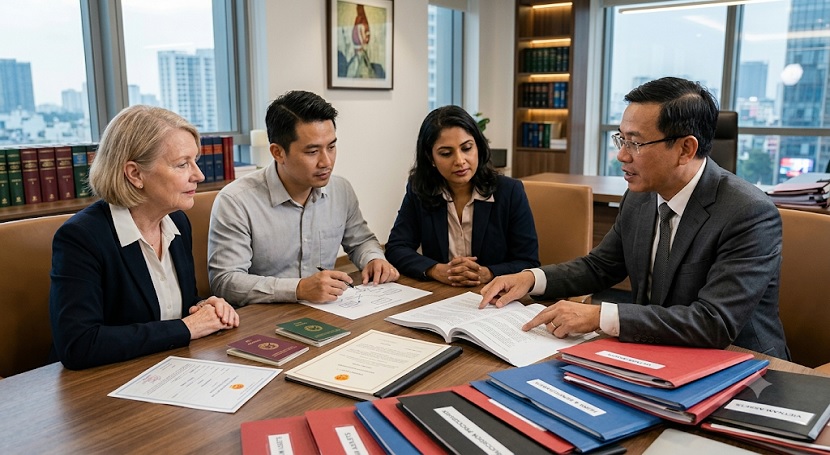
For inheritance in Vietnam for overseas Vietnamese and foreigners, the starting point is the deceased person’s will. The Civil Code 2015 recognises succession under a will and statutory succession, while also addressing civil relations with foreign elements. A foreign national or a person living outside Vietnam may be named as an heir under a will. Whether that person ultimately acquires inheritance rights depends on the validity and applicable law of the succession, while the ability to retain or register a particular asset is a separate question governed by the rules applicable to that asset.
Where there is no valid will, or where the will does not dispose of the entire estate, the heirs must be identified under the law applicable to the succession. In a cross-border case, this may require considering the law of the deceased’s nationality immediately before death, while the exercise of inheritance rights concerning immovable property located in Vietnam is governed by Vietnamese law.
Being named in a will, acquiring inheritance rights, receiving the economic value of an inheritance and retaining or registering a particular asset are related but distinct matters. An overseas or foreign heir may acquire a share of the estate but may need to sell, transfer or receive the value of an asset if Vietnamese law does not permit that person to hold or register the relevant right. This distinction is particularly important for land use rights, ownership of houses and assets attached to land.
The legal status of an overseas heir must be examined rather than assumed. A Vietnamese citizen residing overseas is not necessarily treated in the same way as a person of Vietnamese origin who no longer holds Vietnamese nationality. A foreign national, a stateless person and a person with multiple nationalities may also present different questions concerning identification, applicable law and property eligibility.
Cross-border cases may require a limited conflict-of-laws analysis. The law applicable to the succession may determine matters such as who inherits and in what capacity, while Vietnamese law governs the exercise of inheritance rights concerning immovable property located in Vietnam. Vietnamese notarisation, registration and asset-handling procedures also apply when the relevant acts are carried out in Vietnam.
The place where a will was made, the deceased person’s nationality immediately before death, the heir’s nationality, the location of the assets and the legal form of each asset should therefore be reviewed together.
.jpg)
An estate in Vietnam may include cash, bank accounts, shares, capital contributions, vehicles, personal property, houses, apartments, construction works, land use rights and other property rights. Different asset categories may involve different institutions, registration procedures and documentary requirements.
Money and bank accounts are often administratively demanding even where the family agrees. A bank may need evidence of death, the inheritance basis, the identity of all relevant heirs and a valid notarised document or court decision. If funds are to be transferred abroad, the receiving bank and Vietnamese bank may also require documents explaining the lawful source of the money and compliance with foreign exchange procedures.
Shares and capital contributions require a review of the company’s records, charter, shareholder or member status and any restrictions applying to the relevant business sector. An heir may acquire an economic interest in the inheritance but may not always be able to become the registered holder without satisfying corporate, investment or foreign ownership requirements. In some cases, a transfer or redemption arrangement may be more practical than direct registration.
Vehicles, jewellery and other movable assets are generally easier to identify, but ownership records, physical possession and registration requirements can still cause delay. A vehicle, for example, normally requires a change of registration, while valuable personal property may require evidence that it actually belonged to the deceased rather than another family member.
Real estate requires the most careful distinction. Land in Vietnam is under the ownership of the entire people, with the State acting as the representative of the owner. Individuals and organisations may hold land use rights rather than private ownership of land. Houses and assets attached to land may have a separate ownership status.
An overseas Vietnamese or foreign heir may acquire inheritance rights in relation to an asset, yet the ability to retain or register land use rights or ownership of a house depends on the heir’s legal status and the asset’s eligibility under the Land Law 2024, as amended and supplemented, the Housing Law 2023 and the applicable registration regulations. Where direct registration is unavailable, the heir may need to transfer the asset or receive its economic value through a legally compliant process.
A separate guide explains real estate ownership in Vietnam for foreigners in greater detail.
Taxes, registration fees, notarisation charges and administrative costs should be checked by asset type and family relationship. Vietnamese law may provide exemptions in some close-family cases, but no single tax conclusion applies to every inheritance.
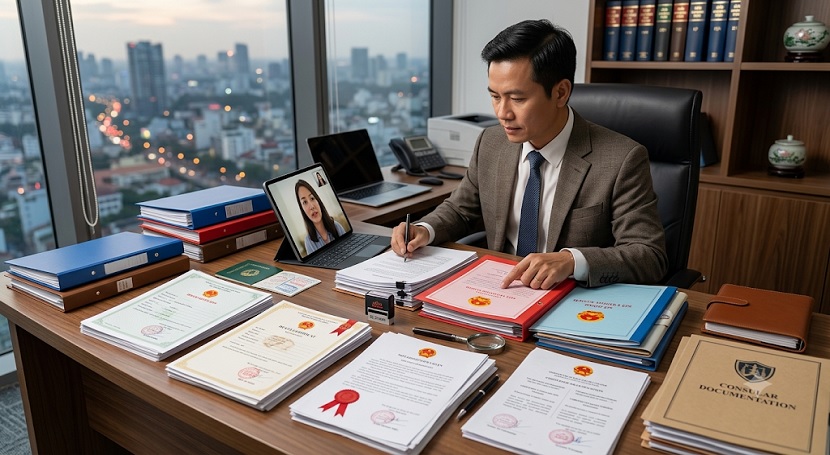
The inheritance procedure in Vietnam should be planned around the actual estate, the law applicable to the succession and the heir’s legal status. A bank account, a company interest and a land-related asset may each require additional documents or separate procedures.
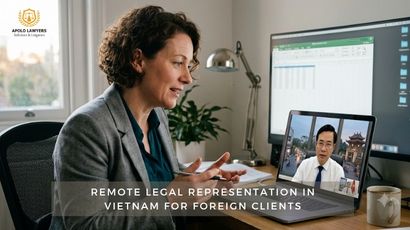
Remote inheritance procedures in Vietnam are possible for some tasks, but not every step can automatically be completed through a power of attorney. The scope and form of the authority must match the specific work, and a notary, bank or authority may still require personal identification, an original signature or direct attendance for a particular act.
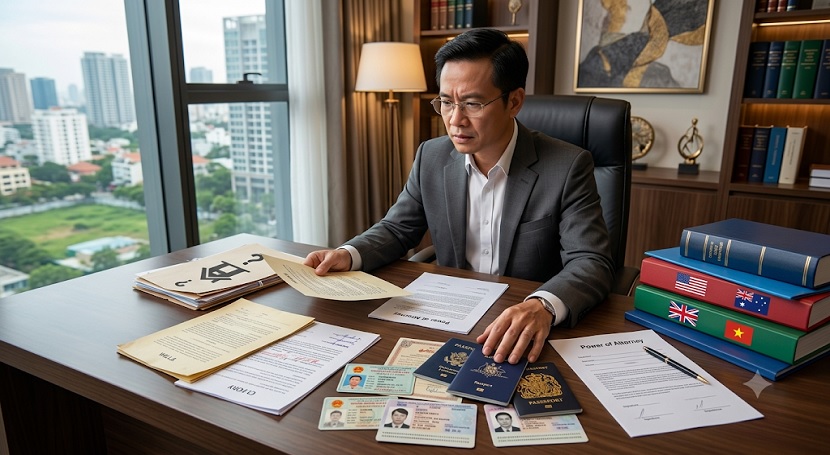
The most common problems are often documentary rather than theoretical. A will may be unsigned, witnessed incorrectly, made in more than one version or inconsistent with later documents. A foreign will may also raise questions about translation, certification, the testator’s capacity, the law applicable to its validity and whether the document can be used for a specific procedure in Vietnam.
Another risk is failing to identify all heirs under the law applicable to the succession. Families with members in several countries may overlook a child, spouse or other person whose civil-status records are held abroad. An inheritance agreement signed without a necessary heir may later be challenged, even after an asset has been transferred.
Land and housing files may contain an old certificate, an informal transfer, an incorrect owner name or a building that has not been fully recorded. Before discussing division, the family may need to clarify the title, co-ownership, marital property and the legal status of assets attached to land. A person occupying the property may also refuse access to documents or resist cooperation.
Disagreement may concern the validity of the will, the identity of the heirs, the value of the assets or the percentage each person should receive. A concise overview of inheritance disputes in Vietnam explains common dispute patterns.
Where co-heirs cannot agree on how the estate should be allocated, the settlement of disputes over division of inheritance may require negotiation, evidence review or court proceedings.
A person may also acquire inheritance rights but be ineligible to retain or register a particular asset. In that situation, the legal and practical route for transferring the asset or receiving its value should be examined before the heirs sign a division agreement.
Foreign documents create another layer of risk. A document may be genuine but unusable because it has not been legalised, translated or certified correctly. The same issue arises with a power of attorney that is too broad, too narrow or inconsistent with the receiving authority’s requirements.
Time limits and procedural deadlines also matter. The relevant period may depend on the claim, the asset and the procedural route. Overseas heirs should therefore avoid delaying a preliminary review, particularly where another person is managing, renting, transferring or withdrawing value from the estate.

A lawyer can first assess whether a person appears to be named as an heir or may acquire inheritance rights under the law applicable to the succession. That question should then be separated from the person’s ability to retain or register each asset in Vietnam.
This review may cover the will, family relationships, nationality, Vietnamese-origin evidence, asset ownership and any indication that part of the property belongs to a surviving spouse or another co-owner. It may also identify whether an heir should seek direct registration, a transfer of the asset or payment of the inheritance’s economic value.
Lawyers can then prepare a document plan for the country where the heir resides. This may include identifying which civil-status and identity documents are needed, checking consular legalisation requirements, coordinating Vietnamese translations and preparing a power of attorney where representation is legally permitted.
For the Vietnam side of the matter, legal assistance may include:
The practical objective is to choose a route that matches both the inheritance entitlement and the heir’s eligibility concerning the particular asset. Direct registration may be appropriate in one case, while a transfer and receipt of value may be safer or legally necessary in another. Representation can reduce unnecessary travel, but the possibility of remote completion and any personal attendance requirement must be checked for each procedure.
For an initial assessment, please contact Apolo Lawyers with information about the deceased person, the assets located in Vietnam, the documents currently available and the country where the heir resides.
Address: 108 Tran Dinh Xu Street, Cau Ong Lanh Ward, Ho Chi Minh City, Vietnam
Tel: (+8428) 66.701.709 | (+84) 908.043.086
Email: contact@apolo.com.vn
Hotline: (+84) 903.600.347
Address: 9th/F, Tower K&M Building, 33 Ung Van Khiem St., Thanh My Tay Ward, HCM City, Vietnam
Tel: (+8428) 35.059.349 | (+84) 908.097.068
Email: contact@apolo.com.vn
Hotline: (+84) 979.48.98.79